

HOME>Experiments>For Lab>EL004 Alkali Precipitation
The acidity of an iron(III) chloride aqueous solution can be visualized by using sodium bicarbonate.
After the experiment, any leftover heavy metal solution should be disposed of using the proper disposal methods.
Aqueous solutions of transition metal salts, such as iron and copper, are colored, making it difficult to confirm their acidity using pH test strips. Therefore, by adding baking soda to these solutions, the strength of the acid can be visualized.
Requires
equipments
・large test tube×10
reagents
・0.10 mol/L iron(III) chloride solution 400 mL
・sodium bicarbonate
Preparation
1.
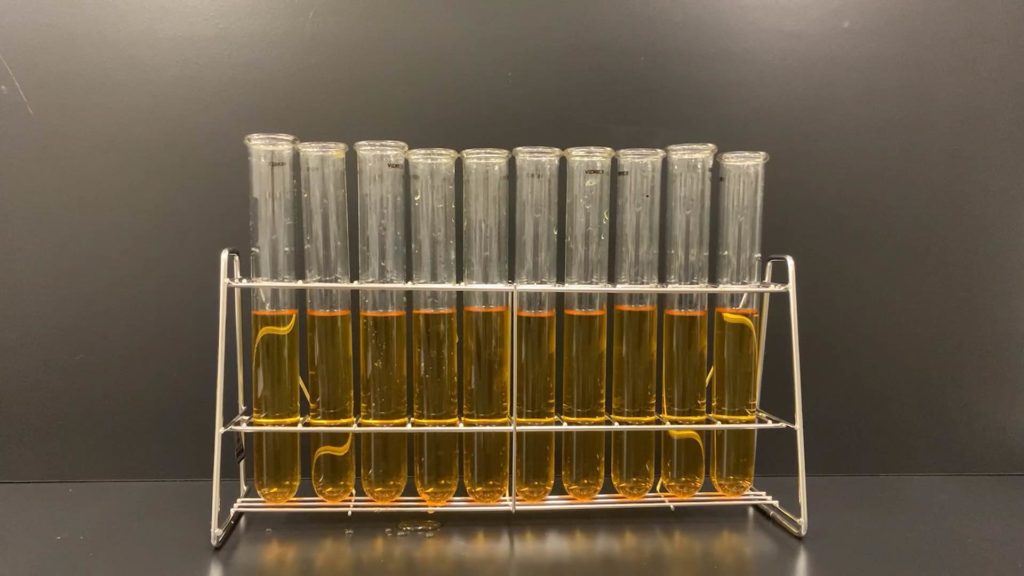
Add 40 mL of iron(III) chloride aqueous solution to each of the 10 test tubes.
2.
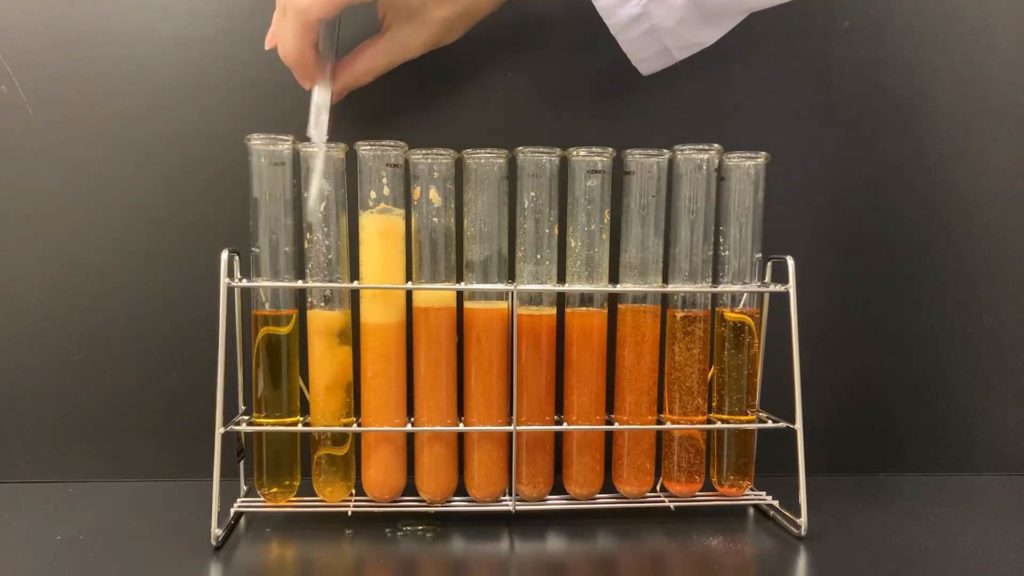
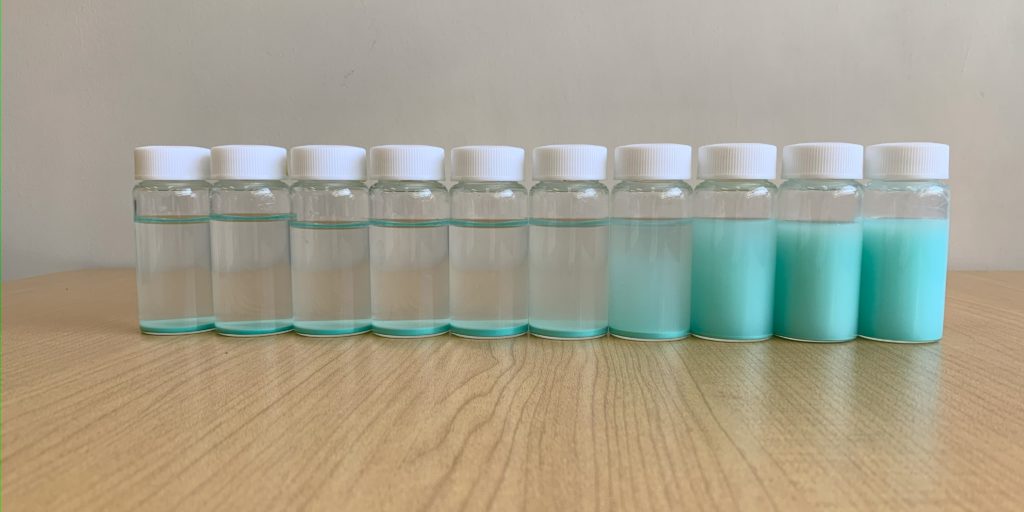
Add baking soda to the test tubes, starting from the first one, increasing the amount by 0.1 g at a time: 0.1 g, 0.2 g, 0.3 g, and so on up to 1.0 g in the last test tube.
3.
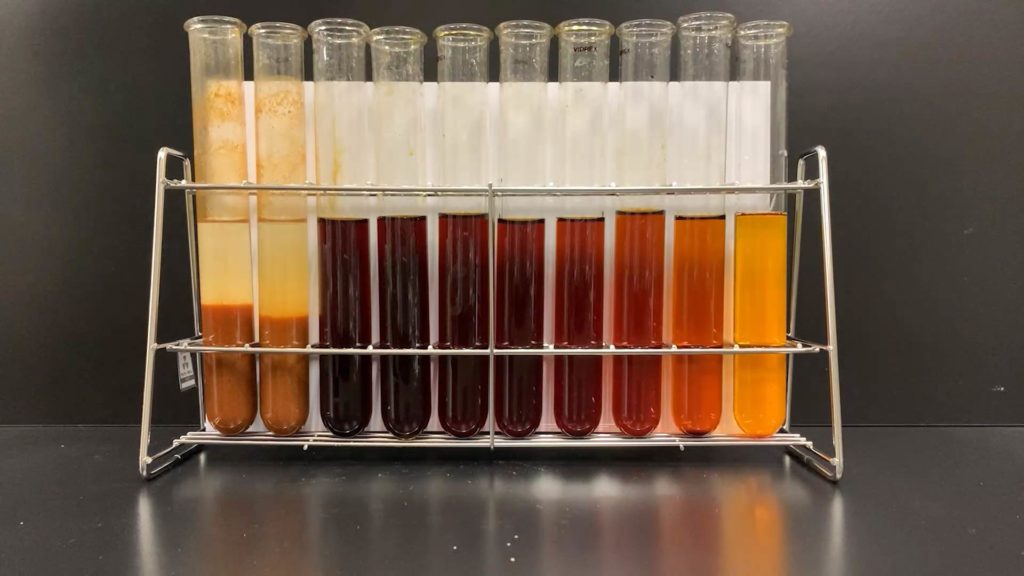
After the reaction, observe the appearance of the test tubes.
Methods
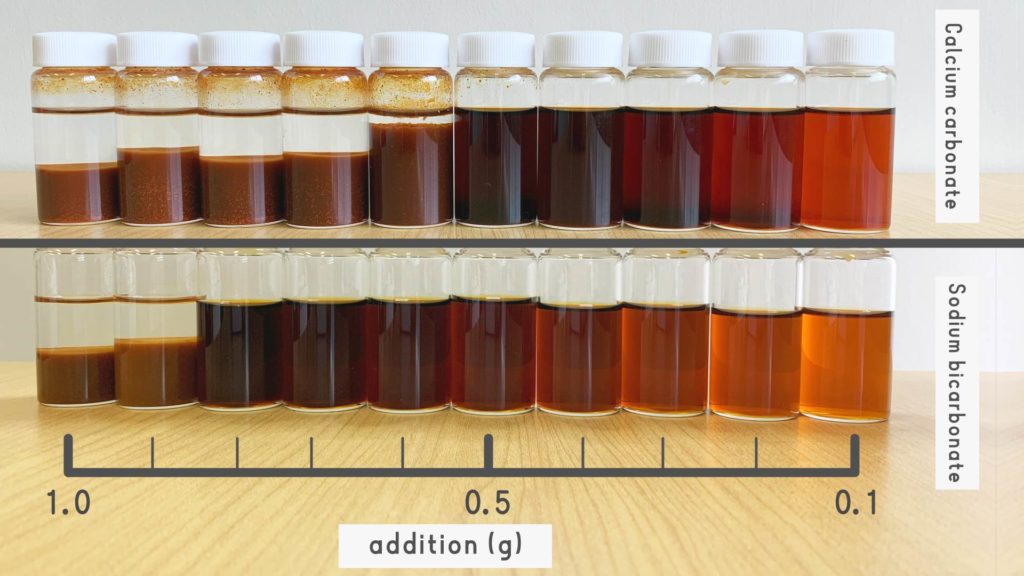
This experiment is described in detail in reference [1]. In this literature, an example using calcium carbonate is introduced. The reaction with calcium carbonate is slower compared to using baking soda.
When comparing the two reaction solutions with baking soda and calcium carbonate, as shown in the image, there is a difference in the amount of precipitate formed. This is related to their different neutralization points. Calcium carbonate is a divalent base, while baking soda is a monovalent base, so calcium carbonate neutralizes with a smaller amount. Once the neutralization point is exceeded, iron hydroxide precipitates.
After the reaction, you can use chemicals such as potassium thiocyanate, which show a color reaction with iron(III) ions, to confirm whether any iron(III) ions remain in the solution [2].
If quantification is required, the “phenanthroline method” would be effective if a spectrophotometer is available. In the case of the EDTA method, since the EDTA solution itself is basic, iron hydroxide forms as the titration progresses, which reduces the accuracy of the results.
A similar experiment can be conducted with copper(II) chloride aqueous solution. If you need to quantify the remaining copper(II) ions in the solution after the reaction, “iodometry” is recommended [3].
reference
[1]陣内大地, 松岡雅忠 “塩化鉄(Ⅲ)の加水分解を視覚化する実験教材の開発” 化学と教育, 69(11), 2021, p.494-497
[2]松岡雅忠, “鉄イオンの呈色反応を利用した面白い実験” 化学と教育, 71(1), 2023, p.16-17
[3]松岡雅忠, ”ヨウ素滴定 ー銅(Ⅱ)イオンの定量ー ” 化学と教育, 62(12), 2014, p.594-595